In the automotive world, there are leaks, there are rumors, and then there are legends in the making. For the past decade, I’ve covered every major truck launch from the electrified Ford F-150 Lightning to the brute-force Ram TRX. But nothing—and I mean nothing—has ignited the imagination of the heavy-duty community quite like the 2026 Caterpillar Pickup Truck.
It’s the vehicle that shouldn’t exist, yet the internet is flooded with “leaked” specs, aggressive renders, and a palpable sense of anticipation. The headline everywhere is the same: “Caterpillar Pickup Truck 2026 Brings Unmatched Power & Rugged Performance.”
But what are we actually looking at? Is this the moment the construction giant crushes the “Big Three” automakers, or is it the ultimate “what if” machine? As a tech and auto expert, I’ve dissected the buzz, the blueprints, and the rumors to bring you a deep-dive analysis of the truck that promises to turn every job site into a playground.
The Core Philosophy: Industrial DNA on Four Wheels
To understand the hype, you have to understand the void this truck fills. Modern pickups like the Silverado High Country or Ford King Ranch have become luxury barges. They have massaging seats and leather dashboards, but they often feel too precious to scratch.
The Caterpillar 2026 concept rejects this softness. The design philosophy here is “Function is Beauty.”
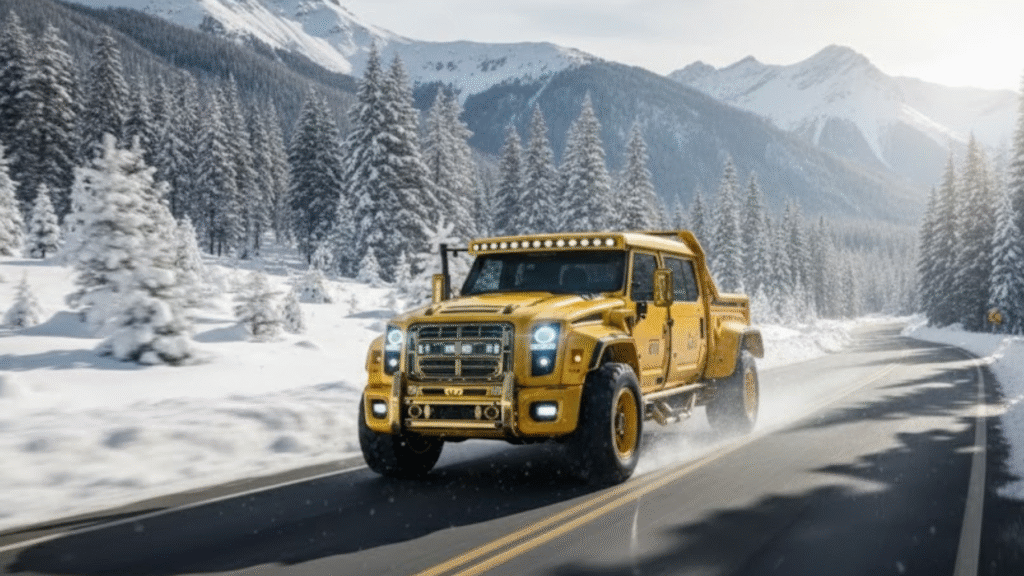
- The “CAT” Aesthetic: The viral imagery showcases a vehicle that borrows heavily from the Caterpillar 797F Mining Truck. We’re talking about a massive, upright grille finished in matte black or industrial honeycomb, flanked by the iconic “Caterpillar Yellow” bodywork.
- Steel Over Plastic: Unlike modern trucks clad in aerodynamic plastic composites, the proposed Caterpillar truck features a reinforced steel exoskeleton. The bumpers aren’t just cosmetic; they are integrated, winch-ready steel beams designed to push, pull, and endure impacts that would total a standard consumer vehicle.
- High-Clearance Stance: The concept rides on what looks like a factory-lifted suspension with 35-inch commercial-grade all-terrain tires, signaling that this isn’t a “pavement princess.” It’s built for the quarry, not the mall parking lot.
Under the Hood: The Rumored Specs That Broke the Internet
This is where the enthusiast forums are losing their minds. A Caterpillar truck cannot just have a “good” engine; it needs an industrial heart. The rumors coalesce around two distinct powertrain configurations that, if produced, would instantly lead the class.
1. The “Earthmover” Diesel (6.7L Inline-Six) The headline act is a rumored 6.7-liter Turbo-Diesel Inline-Six.
- Horsepower: Estimated at 500+ HP.
- Torque: A ground-shaking 1,200 lb-ft.
- The Analysis: This puts it in direct contention with the high-output Ford Power Stroke and Ram Cummins. However, the “Caterpillar difference” would likely be in the torque curve. Industrial engines deliver peak torque almost immediately (around 1,000 RPM), meaning this truck could theoretically tow massive loads without straining the engine, mirroring the behavior of a semi-truck rather than a pickup.
2. The “CAT Hybrid” Powerplant Perhaps the most intriguing rumor is a Diesel-Electric Hybrid.
- The Tech: Caterpillar already builds hybrid construction equipment (like the 336D3 Hybrid Excavator). Applying this to a truck would mean an electric motor providing instant torque for “launch” and towing, while the diesel engine handles highway cruising.
- The Benefit: This could theoretically offer 28+ MPG—a figure unheard of in the heavy-duty segment—while acting as a massive mobile generator (7.2kW to 9.6kW) to power job site tools directly from the bed.
Capabilities: Redefining “Heavy Duty”
If the 2026 Caterpillar Pickup adheres to the brand’s standards, it wouldn’t just compete; it would dominate. Here is the projected capability breakdown based on the rumored chassis architecture.
- Towing Capacity: 30,000+ lbs. Current one-ton trucks max out around 35,000-40,000 lbs with a gooseneck hitch. A Caterpillar entry would likely prioritize stability under load. The chassis is rumored to use a fully boxed, hydroformed steel frame that is significantly thicker than the competition, reducing frame flex to near zero.
- Payload: 6,000+ lbs. This is where the “rugged performance” shines. Most trucks sag under heavy payload. The Caterpillar concept features a rumored self-leveling hydraulic suspension (borrowed from their heavy machinery tech) that automatically adjusts ride height regardless of what you dump in the bed.
- The “Iron Bed”: Forget aluminum or composite beds. The expectation here is a bed lined with impact-resistant Hardox steel, capable of taking loads of jagged rock or scrap metal without needing a spray-in liner.
Interior: The “Mobile Command Center”
The most insightful part of this concept is the interior direction. It’s not trying to be a Mercedes; it’s trying to be a high-end excavator cab.
- Durability First: We are looking at marine-grade vinyl seats that are comfortable but waterproof and stain-resistant. The floors? Rubberized with drain plugs, allowing you to hose out the mud after a shift.
- Tactile Controls: In an era of touchscreens, the Caterpillar 2026 concept brings back oversized, knurled physical buttons and toggle switches. Why? Because you can’t operate a touchscreen wearing heavy work gloves.
- The Tech Layer: Despite the ruggedness, it’s smart. The dashboard is rumored to feature Cat Connect integration, a telematics system that monitors engine health, tire pressure, and load weight in real-time, sending data to fleet managers or the owner’s smartphone.
Pros & Cons: The Expert Analysis
Even a dream truck has potential downsides. Here is my objective take on the concept:
The Pros:
- Unrivaled Durability: A truck built by the people who build bulldozers would likely last a million miles, not just 200,000.
- Resale Value: The “Caterpillar” badge alone would make this the most depreciation-proof vehicle on earth.
- Job Site Utility: Integrated hydraulics or high-voltage power outlets would eliminate the need for separate generators or compressors.
The Cons:
- Ride Quality: A suspension built for 30,000 lbs of towing will likely be incredibly stiff and uncomfortable when empty.
- Emissions & Regulation: Fitting a true industrial-grade diesel engine into a consumer vehicle that meets EPA road regulations is a massive, expensive engineering hurdle.
- The ” Vaporware” Risk: Designing a truck is easy; manufacturing it at scale is hell. Caterpillar has no existing consumer dealer network for road vehicles.
The Reality Check: Is It Real?
As a responsible expert, I must address the elephant in the room. As of late 2025, Caterpillar Inc. has not officially confirmed the production of this truck.
The images you see are largely the work of talented automotive artists and AI, fueled by a public that is tired of fragile, overpriced pickups. However, the persistence of these rumors forces us to ask: Why not?
Caterpillar has the engine tech. They have the chassis knowledge. And clearly, they have a market that is begging for a vehicle that prioritizes “rugged performance” over luxury gimmicks.
Conclusion: The Truck We Need
The Caterpillar Pickup Truck 2026 represents more than just a vehicle; it represents a movement. It is a rejection of the “lifestyle truck” and a demand for a return to the “work truck.”
Whether this beast ever rolls off an assembly line or remains the internet’s favorite ghost, it has already set a new benchmark. It has shown the “Big Three” (Ford, GM, Ram) that there is a massive appetite for a vehicle that is simple, unbreakable, and unapologetically powerful.
