

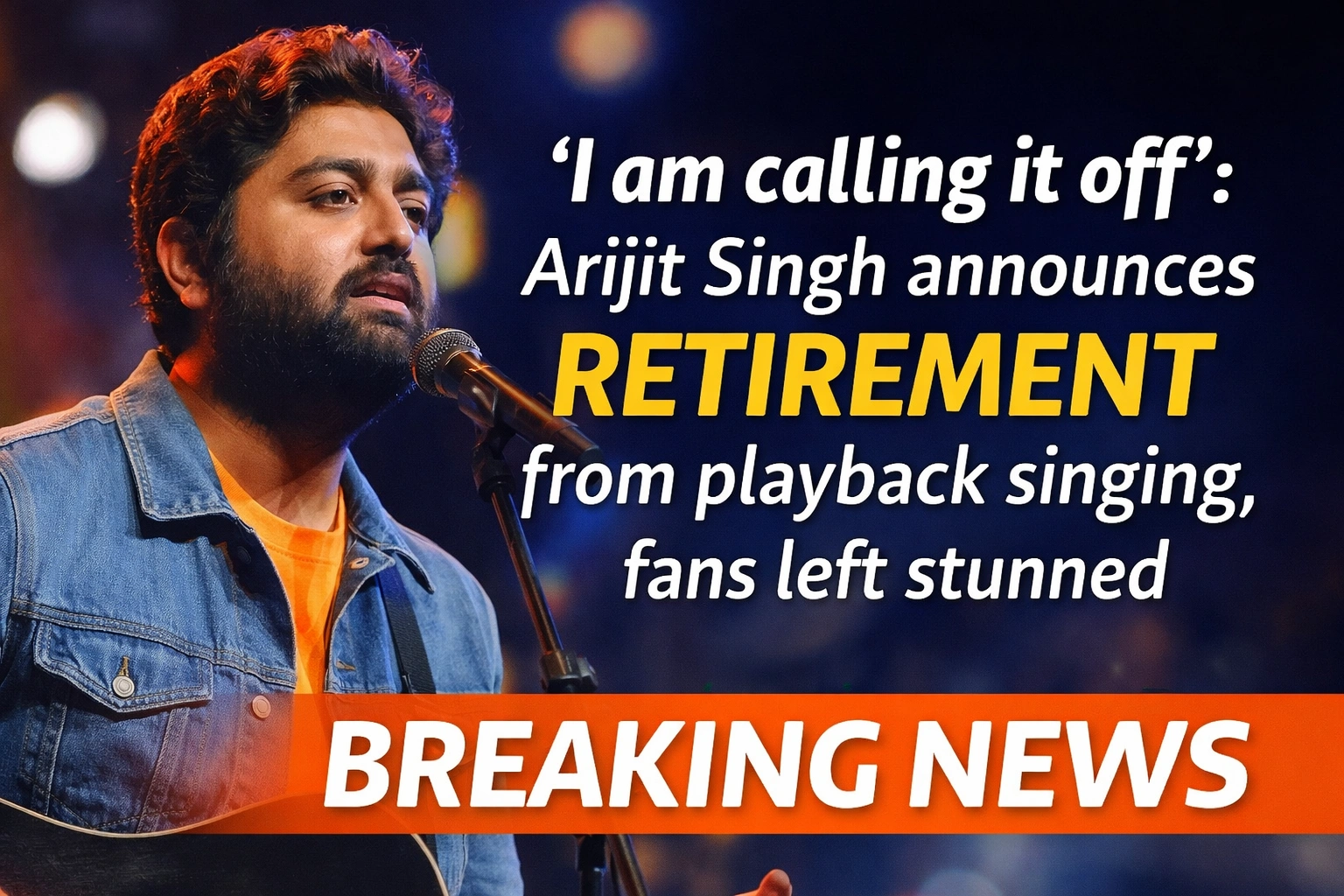
MUMBAI — The announcement came without warning. No press conference. No formal statement through his record label. Just a handful of words posted on social media late Sunday evening that sent shockwaves through India’s entertainment industry and left millions of fans across the globe grappling with disbelief.
Arijit Singh, the voice behind some of Bollywood’s most soul-stirring melodies over the past decade and a half, has announced his retirement from playback singing.
“I am calling it off,” the 37-year-old singer wrote in a brief Instagram post that has since been shared millions of times. “Thank you for the love. Thank you for the music. This journey ends here.”
Within minutes, the post ignited a firestorm. Twitter crashed temporarily under the weight of trending hashtags. WhatsApp groups exploded with speculation. Music directors, fellow artists, and industry veterans scrambled to make sense of a decision that nobody saw coming.
For an industry that has weathered countless storms—from the decline of physical album sales to the pandemic’s body blow to live performances—Arijit Singh’s retirement represents something far more profound: the potential end of an era that redefined what playback singing could be in modern Indian cinema.
The Voice That Defined a Generation
To understand the magnitude of this moment, you need to grasp what Arijit Singh means to contemporary Bollywood music.
Since his breakthrough with “Tum Hi Ho” in 2013’s Aashiqui 2, Singh hasn’t just been a playback singer—he’s been the emotional heartbeat of Hindi cinema. His voice has carried love confessions in darkened theaters, soundtracked first kisses in college dorms, and provided solace during heartbreaks from Delhi to Dubai.
The numbers tell part of the story:
- 500+ songs recorded across multiple languages including Hindi, Bengali, Tamil, and Telugu
- 7 Filmfare Awards for Best Male Playback Singer
- Estimated net worth between $75-80 million, making him one of India’s wealthiest musicians
- 60+ million followers across social media platforms
- Billions of streams on digital platforms, with songs like “Channa Mereya” and “Ae Dil Hai Mushkil” each crossing 500 million views on YouTube
But statistics alone don’t capture Singh’s cultural impact. He arrived at a time when Bollywood music was increasingly dominated by peppy dance numbers and item songs. Singh brought back the romantic ballad, the melancholic melody, the heartbreak anthem—and made them commercially viable again.
LIVE UPDATE FROM THE INDUSTRY
“This is not just the retirement of a singer. This is the closing of a chapter in Indian film music. Arijit brought a certain authenticity and emotional depth that connected with listeners in ways we haven’t seen since the golden era of Kishore Kumar and Mohammed Rafi.”
— Amit Trivedi, Music Composer, in an exclusive statement to PTI
What We Know About the Retirement Announcement
The brevity of Arijit Singh’s announcement has only intensified speculation about what prompted this sudden decision.
Key Details:
- Timing: Posted at 11:47 PM IST on Sunday, January 26, 2026
- Platform: Instagram (his primary social media account with 45 million followers)
- Length: Just 18 words in English, followed by a single folded-hands emoji
- No explanation: No mention of health issues, creative burnout, or future plans
- No comeback hint: Unlike some celebrity “retirements,” there was no ambiguity in his language
Within hours, the post garnered over 15 million likes and 800,000 comments—many from fans pleading with him to reconsider, others expressing gratitude for years of musical companionship.
Notable responses flooded in from across the industry:
Pritam Chakraborty (Music Director): “Can’t believe what I’m reading. Arijit, you’ve given voice to emotions I couldn’t express with just my compositions. This can’t be the end.”
Shreya Ghoshal (Playback Singer): “Some voices are irreplaceable. Yours is one of them, Arijit. The industry won’t be the same.”
Shah Rukh Khan (Actor): “The man who made my recent films sound the way they did. Heartbroken but respectful of whatever decision you’ve made.”
Decoding the Silence: Why Now?
Industry insiders—speaking on condition of anonymity given the sensitivity of the situation—point to several potential factors that may have contributed to Singh’s decision to retire from playback singing at the height of his career.
The Artistic Burnout Factor
Those close to the singer describe a man increasingly frustrated with Bollywood’s assembly-line approach to music production.
“Arijit has been vocal in private circles about the lack of creative freedom,” reveals a Mumbai-based music producer who has worked with Singh on multiple projects. “He’s been asked to remake his own hits, to sound like ‘Arijit Singh’ rather than being allowed to evolve as an artist. That takes a toll.”
Singh has recorded an average of 35-40 songs per year since 2014—a punishing schedule that leaves little room for artistic experimentation or personal projects.
The Streaming Economics
Despite his massive popularity, Singh has reportedly been in disputes with major music labels and streaming platforms over royalty structures.
A comparison of artist earnings:
| Revenue Stream | Traditional Era (Pre-2010) | Streaming Era (Current) |
| Album Sales | ₹15-20 per copy to artist | Negligible |
| Radio Royalties | Substantial recurring income | Minimal in digital age |
| Streaming Royalties | N/A | ₹0.001-0.004 per stream |
| Live Performances | Secondary income | Now primary revenue source |
For context: a song with 100 million streams might generate only ₹10-15 lakhs for the singer, while the same song could have earned multiples of that amount in the physical album era.
Family and Personal Life
At 37, Arijit Singh is a father of two young children. Multiple sources suggest he’s been contemplating stepping back from the relentless grind of playback singing to spend more time with his family in West Bengal.
“Success in this industry demands constant availability,” notes a close associate. “You’re recording at odd hours, traveling for events, managing multiple projects simultaneously. For someone who values privacy as much as Arijit does, it becomes unsustainable.”
EXPERT ANALYSIS
“We’re seeing a broader trend of established artists re-evaluating their relationship with the mainstream music industry. Arijit Singh’s retirement could catalyze similar decisions among other playback singers who feel undervalued in the current ecosystem. The streaming economy has fundamentally altered the power dynamics between artists and platforms.”
— Dr. Radhika Chopra, Professor of Media Studies, Jamia Millia Islamia University
The Arijit Singh Legacy: A Career in Numbers and Notes
To truly appreciate what the industry stands to lose, consider the arc of Singh’s remarkable career.
The Early Struggles
Born in Jiaganj, Murshidabad, West Bengal, Arijit Singh’s path to stardom was anything but smooth. After finishing as a runner-up in the 2005 reality show Fame Gurukul, he spent nearly eight years doing background vocals and assistant work before his big break.
His age—37 years old—makes this retirement particularly poignant. Most playback singers hit their commercial peak in their 40s and 50s, riding on established reputation and industry relationships.
The Breakthrough and Beyond
2013: “Tum Hi Ho” from Aashiqui 2 becomes a cultural phenomenon
2014-2016: Establishes dominance with hits like “Muskurane,” “Sooraj Dooba Hain,” “Gerua”
2016-2018: Peak creative period with “Ae Dil Hai Mushkil,” “Channa Mereya,” “Hawayein”
2019-2021: Expands into regional cinema, explores diverse genres
2022-2025: Maintains position as Bollywood’s most sought-after voice
2026: Announces retirement, leaving multiple unreleased projects in limbo
What Made His Voice Different
Music critics and vocal coaches point to several technical and emotional qualities that set Arijit Singh apart:
- Nasal tonality: A distinctive quality that adds vulnerability to romantic ballads
- Emotional range: Equally convincing in songs of longing, heartbreak, celebration, and devotion
- Technical precision: Exceptional breath control and ability to handle complex compositions
- Relatability: A voice that sounds approachable rather than operatic, connecting with common listeners
“He democratized playback singing,” explains classical vocalist Pandit Ajoy Chakrabarty. “You didn’t need to understand raga or taal to feel what he was expressing. That’s a rare gift.”
The Industry Scrambles: What Happens to Pending Projects?
Perhaps the most immediate crisis triggered by Arijit Singh’s retirement announcement concerns the dozens of unreleased films that feature his voice.
Films in Post-Production:
- At least 12 major Bollywood releases scheduled for 2026 feature Arijit Singh songs
- Multiple regional cinema projects (Tamil, Telugu, Bengali) have contracted him for title tracks
- Several independent music albums were in various stages of production
Industry sources reveal frantic calls between producers, music directors, and the singer’s management team throughout Monday morning.
Key Questions Being Asked:
- Will Singh complete recording sessions for committed projects?
- Can existing contracts be enforced or will they need to be renegotiated?
- Who can possibly fill the void for films that were specifically composed with his voice in mind?
“You can’t just plug in another voice,” explains music director Vishal Dadlani. “Songs are composed keeping the singer’s strengths in mind. Replacing Arijit in a song written for Arijit is like recasting the lead actor after filming is complete—technically possible but artistically compromised.”
The Economic Ripple Effect
The retirement also has significant financial implications:
- Music labels face potential devaluation of upcoming soundtracks
- Concert promoters scramble to cancel or restructure planned tours
- Streaming platforms may see decreased engagement on Bollywood playlists
- Brand endorsements worth an estimated ₹50 crores annually now in question
Fan Reactions: A Global Outpouring of Grief and Gratitude
The response from fans has been nothing short of extraordinary.
Across social media platforms, millions have shared personal stories about what Arijit Singh’s music meant to them. A Twitter thread started by a Mumbai-based teacher asking people to share “the Arijit song that got you through your hardest time” received over 100,000 responses within 24 hours.
Common Themes in Fan Reactions:
- Soundtrack of their lives: Many fans describe how specific songs marked important life moments
- Emotional anchor: Stories of Singh’s music providing comfort during depression, anxiety, heartbreak
- Cultural bridge: International fans noting how his voice introduced them to Bollywood
- Generational marker: Gen Z listeners for whom Singh has been the only dominant romantic voice in Bollywood
Street corner chai shops in Delhi reported playing Arijit Singh compilations on loop Monday morning, with customers sitting in contemplative silence between conversations. College campuses from Bangalore to Kolkata organized impromptu gatherings where students sang his songs together.
“It feels like a collective loss,” says 24-year-old software engineer Priya Malhotra from Pune. “His voice has been the constant background of our entire adult lives. I genuinely don’t know what Bollywood romance will sound like without him.”
What Comes Next: The Future of Playback Singing
Arijit Singh’s retirement forces uncomfortable questions about the state and future of playback singing in India.
The Talent Pipeline
Who fills this vacuum? Several younger singers have emerged in recent years:
- Jubin Nautiyal: Strong romantic repertoire, growing popularity
- Armaan Malik: Pop-influenced style, massive Gen Z following
- B Praak: Dominance in Punjabi cinema, expanding to Hindi films
- Sachet Tandon: Rising star with emotional depth
But none command the universal appeal and consistent quality that Singh brought to every project.
The Structural Challenge
Beyond individual talent, the industry faces systemic issues:
Declining Music Budgets: Films allocate smaller percentages to music production
Formula Over Innovation: Pressure to recreate past hits rather than take creative risks
Streaming Economics: Royalty structures that undervalue artist contributions
Live Performance Pressure: Singers increasingly dependent on concerts for income
“Arijit’s retirement might be the wake-up call the industry needs,” suggests entertainment lawyer Vandana Ghai. “If you can’t retain your biggest star at 37, something is fundamentally broken in how we value musical talent.”
INDUSTRY INSIDER PERSPECTIVE
“The playback singing model itself is under strain. We’re asking artists to be available 24/7, to work across 5-6 films simultaneously, to promote songs on social media, to perform at events—all while the actual recording fees haven’t kept pace with inflation or the revenue these songs generate. Something has to give.”
— Anonymous Music Label Executive
Could This Be a Strategic Break Rather Than Permanent Retirement?
Not everyone is convinced that Arijit Singh’s announcement represents a permanent exit from playback singing.
Entertainment industry observers note several precedents where artists announced “retirement” only to return after negotiating better terms or taking extended breaks:
- A.R. Rahman stepped back from film music in 2018, citing creative dissatisfaction, before returning selectively
- Sonu Nigam famously declared he was “leaving Bollywood” in 2017, then continued recording sporadically
- Shreya Ghoshal has periodically threatened to reduce her Bollywood commitments
“The word ‘retirement’ might be strategic,” suggests brand management consultant Rohan Mehta. “It could be Arijit’s way of resetting expectations—signaling he’ll be more selective, work on his own terms, command higher fees, or focus on independent music. We’ve seen this playbook before.”
However, those closest to Singh insist this feels different.
“There’s a finality in how he’s communicating this,” says a longtime collaborator. “He’s not saying ‘taking a break’ or ‘stepping back.’ He said he’s ‘calling it off.’ For someone who chooses his words carefully, that distinction matters.”
Everything You Need to Know: Comprehensive FAQ
Q: When did Arijit Singh announce his retirement from playback singing?
A: Arijit Singh announced his retirement on Sunday, January 26, 2026, via an Instagram post that simply stated “I am calling it off.”
Q: What is Arijit Singh’s age?
A: Arijit Singh is 37 years old, having been born on April 25, 1987, in Jiaganj, West Bengal.
Q: What is Arijit Singh’s net worth?
A: Arijit Singh’s estimated net worth is between $75-80 million (approximately ₹620-660 crores), derived from playback singing, live performances, brand endorsements, and digital streaming royalties.
Q: Why did Arijit Singh retire from playback singing?
A: While Singh hasn’t provided specific reasons, industry sources point to potential factors including creative burnout, dissatisfaction with streaming economics, desire for family time, and frustration with lack of artistic freedom in Bollywood’s commercial music landscape.
Q: Will Arijit Singh complete songs for unreleased films?
A: This remains unclear. At least 12 major films scheduled for 2026 release feature his vocals, and industry insiders report ongoing discussions between Singh’s team and producers about contractual obligations.
Q: What are Arijit Singh’s most popular songs?
A: His most iconic tracks include “Tum Hi Ho,” “Channa Mereya,” “Ae Dil Hai Mushkil,” “Gerua,” “Hawayein,” “Pal,” “Muskurane,” and “Phir Bhi Tumko Chaahunga,” among hundreds of others.
Q: Can another playback singer replace Arijit Singh?
A: While several talented singers like Jubin Nautiyal, Armaan Malik, and B Praak are rising in prominence, industry experts suggest no single voice can replicate Singh’s unique combination of technical skill, emotional depth, and commercial appeal.
Q: Has any other major playback singer retired at this age?
A: It’s exceptionally rare. Most playback singers work well into their 50s, 60s, and even 70s. Retiring at 37, during one’s commercial prime, is virtually unprecedented in the industry.
The Silence That Speaks Volumes
As Tuesday morning breaks across India, the music industry continues to reel from an announcement that has fundamentally altered Bollywood’s landscape.
Recording studios report an eerie quiet where Singh’s voice would typically dominate playback sessions. Music directors stare at pending compositions, uncertain how to proceed. Millions of fans press play on their favorite Arijit Singh playlists, listening with new awareness that no new chapters will be added to this catalog.
The retirement of a playback singer shouldn’t feel this monumental. But Arijit Singh was never just a playback singer.
He was the voice that millennials fell in love to. The soundtrack to heartbreak for Gen Z. The emotional anchor in a cynical age. The proof that genuine feeling could still sell in an industry increasingly driven by viral hooks and dance challenges.
Whether this marks a permanent goodbye or an extended intermission remains to be seen. What’s undeniable is that Bollywood music enters uncertain territory, searching for a voice to fill a void that seems, for now, unfillable.
