
The smell of sharpened pencils, the rhythmic thud-thud of the invigilator’s footsteps on the wooden floor, and the cold, smooth surface of the wooden desk. You’ve spent months buried in NCERT textbooks, but as the clock starts ticking, your heart races. You know the material, but do you know how to present it?
In the world of CBSE, knowing the answer is only half the battle. The other half is winning over the examiner who is grading thousands of sheets.
This guide is your secret weapon. Whether you are looking for how to write answers in board exams CBSE class 10 or seeking the sophisticated board paper writing style required for CBSE class 12, we’ve got you covered.
The Psychology of the Examiner: Why Presentation Matters
Before we dive into the “how,” let’s talk about the “who.” The person checking your paper is likely an overworked teacher sitting with a stack of 500 scripts. They aren’t looking for reasons to fail you; they are looking for reasons to give you marks quickly.
If your paper is a cluttered mess of scribbles, they have to work hard to find your points. If your paper is a clean, structured masterpiece, you’ve already won their favor.
How to Write Board Exam Paper Class 10 vs. Class 12
- Class 10: Focus on clarity, directness, and sticking to the NCERT keywords.
- Class 12: Focus on depth, logical flow, and technical terminology.
Expert Insight: “Examiners follow a strict ‘Marking Scheme’ provided by CBSE. They aren’t looking for beautiful prose; they are looking for specific ‘Value Points.’ Hit those points, and the marks are yours.”
The First 15 Minutes: Strategy Over Stress
When you get that question paper, your instinct is to start writing immediately. Don’t. CBSE gives you 15 minutes of reading time for a reason.
Use the 15 Minutes To:
- Categorize Questions: Identify the “Easy,” “Medium,” and “Tricky” questions.
- Select Options: In sections with internal choices, decide now which one you can answer better.
- Mental Outlining: For 5-mark questions, visualize your headers and sub-headers.
Mastering the Board Paper Writing Style
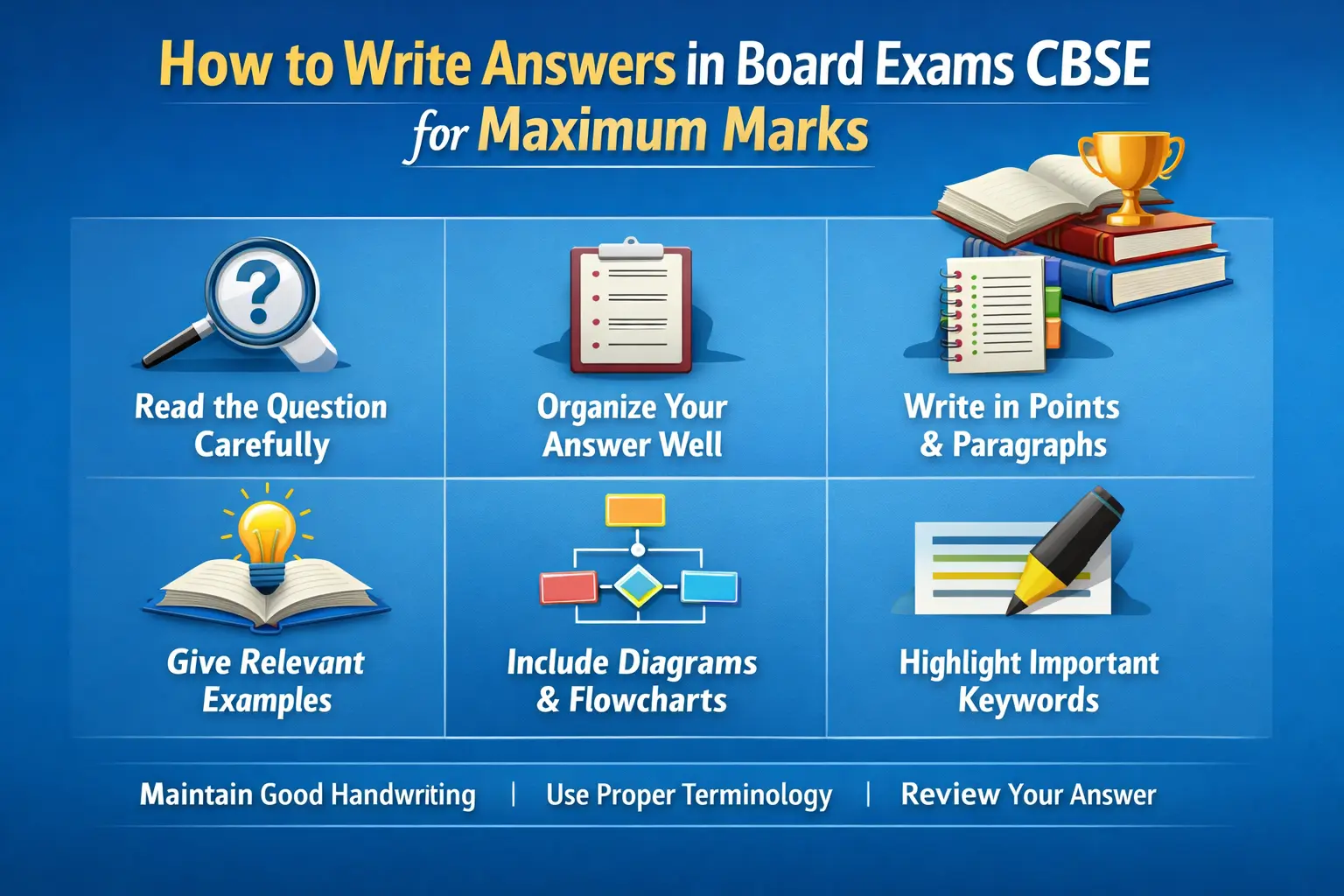
Your board paper writing style acts as the “packaging” for your knowledge. Even an average answer can look like a topper’s response if formatted correctly.
The Anatomy of a Perfect Answer
- The Intro: A one-line definition or restatement of the question.
- The Body: Points, points, and more points. Avoid long paragraphs like the plague.
- The Conclusion: A concluding sentence that ties back to the question.
| Feature | The “Average” Student | The “Topper” Student |
| Format | Long, dense paragraphs | Bullet points and sub-headings |
| Keywords | General language | NCERT-specific terminology |
| Diagrams | Only if asked | Wherever relevant (even in English/BST) |
| Corrections | Heavy scratching/whitener | Single neat line through errors |
How to Write Answers in Board Exams CBSE Class 10
At the Class 10 level, the examiners want to see that you’ve grasped the fundamentals.
Science and Social Science (SST)
- Use Flowcharts: If you’re explaining the process of photosynthesis or the stages of the French Revolution, use a flowchart to show the sequence.
- Highlight Keywords: Use a pencil to underline the most important term in every paragraph.
Mathematics
- Step Marking: Never skip steps. Even if your final answer is wrong, $2/3$ of the marks are in the steps.
- Rough Work: Draw a margin on the right side of the page for calculations. Don’t hide them on the last page.
Pro-Tip: In Class 10 Math, always write the formula used ($a^2 – b^2 = (a-b)(a+b)$) in a box next to the step. It signals mathematical maturity.
How to Write Answers in Board Exams CBSE Class 12
Class 12 demands a higher level of analytical thinking. Here is how to write answers in CBSE board exams when the stakes are at their highest.
Physics and Chemistry
- Derivations: Start with a clear diagram and a “Let us consider…” statement.
- Units: Never forget the SI units ($J, N, m/s^2$). A missing unit can cost you half a mark.
Humanities and Commerce
- Case Studies: Always quote the line from the passage that supports your answer.
- Business Studies: Use the “Definition – Features – Importance” structure for long answers.
General Tips for Board Exam Success
To truly master how to write answers in board exams, you need to manage your physical and mental space during those three hours.
The “No-Paragraph” Rule
Unless it’s a letter in English, try to avoid paragraphs longer than three lines. Human eyes naturally skip over dense text. Use bullet points to make your points “pop.”
Use of Pencils vs. Pens
- Blue Ball/Gel Pen: For writing.
- Pencil: For diagrams, underlining keywords, and drawing margins.
- Black Pen: Only if allowed for headings (check latest CBSE guidelines).
Time Management Table (3-Hour Paper)
| Section | Marks | Suggested Time |
| Section A (MCQs) | 20 | 25 Minutes |
| Section B (Short) | 12-15 | 30 Minutes |
| Section C (Medium) | 20-24 | 50 Minutes |
| Section D (Long) | 15-20 | 50 Minutes |
| Revision | – | 25 Minutes |
The Power of Visuals: Diagrams and Tables
A picture is worth a thousand marks. Even in subjects like Economics or Biology, a well-labeled diagram can save you from writing 200 words.
- Biology: Use sharp pencils. Labels should all point to one side if possible.
- Economics: Ensure your graphs have labeled X and Y axes.
- Literature: Character sketches can be presented as “mind maps.”
Expert Insight: “Always draw your diagrams first if you are running out of time. You can get 70% marks for a correct diagram even without the explanation, but 0% for an explanation without a mandatory diagram.”
Handling the “I Don’t Know This” Moment
We’ve all been there. You see a 4-mark question and your mind goes blank. Here is how to write answers in board exams when you’re stuck:
- Don’t Panic: Take a deep breath.
- Find the Root: What chapter is this from? What are the basic concepts of that chapter?
- Write the Basics: Write the definition of the terms in the question. You might get 1 mark for the attempt.
- Logical Guessing: If it’s Science, think of the law that might apply. If it’s History, think of the era.
The Final 20 Minutes: The “Topper” Checklist
The exam isn’t over when you finish the last question. It’s over when the bell rings. Use the final 20 minutes for:
- Question Numbering: Ensure your answer numbers match the question paper. This is a common, fatal error.
- Underlining: Go through your paper and underline the key technical terms.
- Closing Lines: Draw a horizontal line with a pencil after every answer to separate them clearly.
- Filling Gaps: If you left space for a difficult question, try to write something now.
Conclusion: Your Journey to 95%+
Mastering how to write answers in board exams CBSE is a skill, not a gift. It requires practice, a bit of strategy, and the empathy to understand what your examiner needs. By using bullet points, highlighting keywords, and managing your time effectively, you aren’t just answering questions—you are telling the examiner that you deserve the highest marks.
You have the knowledge. Now, give it the presentation it deserves.
Frequently Asked Questions (FAQs)
Q1: Is handwriting important in CBSE board exams?
It doesn’t have to be “beautiful,” but it must be legible. If the examiner can’t read it, they can’t mark it. Focus on proper spacing between words.
Q2: What if I write more than the word limit?
CBSE doesn’t penalize you for exceeding the word limit, but you waste precious time. It’s better to write a concise, high-quality answer than a long, rambling one.
Q3: Can I use a whitener to fix mistakes?
It’s best to avoid it. If you make a mistake, simply draw a single neat line through it. It looks much cleaner than a blob of white fluid.
Q4: Should I answer questions in order?
Ideally, yes. It makes the examiner’s life easier. However, if you are stuck, you can move to the next section. Just make sure to label the Section and Question Number very clearly.
Q5: How do I write the “Conclusion” in 5-mark questions?
Summarize the main point in one sentence starting with words like “Hence,” “Therefore,” or “In a nutshell.”