Mobile SEO has become a fundamental part of search engine optimization as mobile devices now dominate how people access the internet. Smartphones and tablets are the primary tools for searching products, services, and information online. Because of this shift, search engines prioritize mobile-friendly websites when ranking pages in search engine results pages (SERPs).
Mobile SEO ensures that your website performs efficiently on mobile devices by improving speed, usability, content layout, and accessibility. In this article, you’ll learn why Mobile SEO matters, how it works, and how to optimize your site effectively using proven and up-to-date strategies.
What Is Mobile SEO
Mobile SEO is the process of optimizing a website to ensure it delivers an excellent experience to users accessing it through mobile devices such as smartphones and tablets. It focuses on improving site speed, responsiveness, navigation, content readability, and technical performance specifically for mobile users.
Unlike traditional SEO, Mobile SEO accounts for mobile-specific factors like touch navigation, smaller screens, variable internet speeds, and device compatibility. Since search engines now evaluate websites primarily from a mobile perspective, Mobile SEO plays a direct role in determining search rankings.
The main goal of Mobile SEO is to help websites rank higher in mobile search results while offering a smooth and user-friendly mobile experience.
Why Mobile SEO Matters
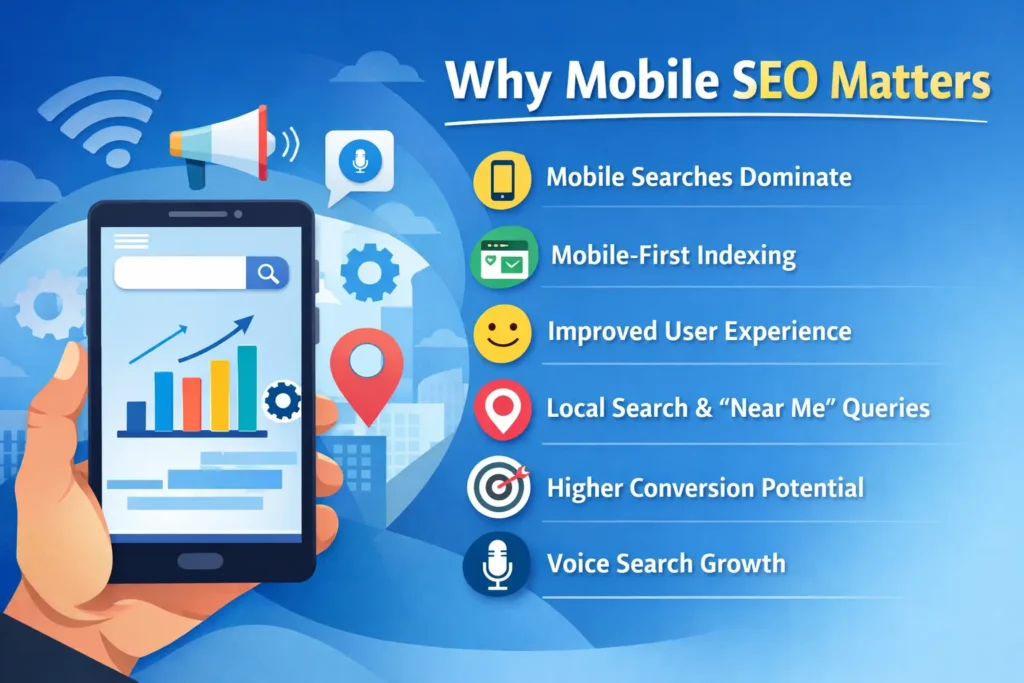
Mobile SEO is essential in today’s digital environment for several important reasons.
1. Mobile Searches Dominate
More than half of global internet traffic comes from mobile devices. A website that is not optimized for mobile risks losing a significant portion of its potential audience.
2. Mobile-First Indexing
Search engines primarily use the mobile version of a website for indexing and ranking. If your mobile site is poorly optimized, your overall SEO performance will suffer.
3. Improved User Experience
Mobile SEO enhances usability by ensuring fast loading pages, readable text, and easy navigation, leading to better engagement and lower bounce rates.
4. Stronger Local Visibility
Many mobile searches are location-based. Mobile SEO helps businesses appear in local search results and “near me” queries.
5. Higher Conversion Potential
A mobile-optimized site makes it easier for users to take action, increasing conversions, leads, and sales.
6. Voice Search Growth
Voice searches are commonly performed on mobile devices. Mobile SEO supports conversational queries and natural language search patterns.
Best Mobile SEO Practices
Implementing best Mobile SEO practices helps ensure your website remains competitive and search-friendly.
1. Use Responsive Design
Responsive design allows your website to adjust automatically to different screen sizes, providing a consistent experience across devices.
2. Optimize Page Speed
Fast loading pages are critical for mobile users. Compress images, reduce scripts, and optimize server performance to improve speed.
3. Improve Mobile Content Readability
Use short paragraphs, clear headings, and bullet points to make content easy to scan on small screens.
4. Ensure Touch-Friendly Navigation
Buttons, menus, and links should be large enough to tap easily without zooming.
5. Avoid Intrusive Pop-Ups
Large pop-ups can disrupt the mobile experience and negatively affect rankings.
6. Optimize for Local and Voice Search
Use location-based keywords and conversational phrases to capture mobile and voice search traffic.
These Mobile SEO practices help improve rankings, usability, and engagement while meeting modern search engine requirements.
How to Optimize Your Site Using Mobile SEO
Optimizing your site for Mobile SEO involves a combination of technical improvements and user-focused enhancements.
1. Implement Responsive Web Design
Ensure your website adapts smoothly to all screen sizes using flexible layouts and CSS media queries.
2. Optimize Mobile Page Speed
Reduce page weight by compressing images, minimizing code, and enabling browser caching.
3. Create Mobile-Friendly Content
Focus on clarity and simplicity. Highlight key information early and avoid unnecessary clutter.
4. Improve Navigation Structure
Keep menus simple and ensure users can reach important pages easily.
5. Optimize Images and Media
Use mobile-compatible formats and reduce file sizes without sacrificing quality.
6. Strengthen Local SEO
Add accurate business details and location-specific keywords to improve local visibility.
7. Optimize for Voice Search
Write content that answers questions directly using natural, conversational language.
8. Test Mobile Usability Regularly
Regular testing helps identify issues that affect mobile performance and rankings.
Different Ways to Configure a Website for Mobile
1. Responsive Design
A single website that adjusts automatically to all devices.
Benefits:
- Google-recommended
- Easier maintenance
- Consistent user experience
2. Dynamic Serving
The server delivers different content based on the user’s device while keeping the same URL.
Benefits:
- Device-specific optimization
- Efficient resource usage
3. Separate URLs
Different URLs for desktop and mobile versions (such as m.example.com).
Drawbacks:
- Higher maintenance
- Potential SEO issues if misconfigured
Common Mobile SEO Mistakes
1. Slow Mobile Pages
Poor speed leads to higher bounce rates and lower rankings.
2. Inconsistent Content
Missing content on mobile compared to desktop harms SEO.
3. Unplayable Media
Media that doesn’t work on mobile devices frustrates users.
4. Faulty Redirects
Incorrect redirects damage usability and crawlability.
5. Poor Mobile UX
Small buttons, cluttered layouts, and difficult navigation reduce engagement.
6. Too Many Ads
Excessive ads slow pages and negatively affect user experience.
7. Ignoring Local Optimization
Missing local SEO signals reduces visibility in mobile search results.
Read More to Fix Technical SEO Issues
Conclusion
Mobile SEO is no longer optional—it is a critical requirement for modern websites. As mobile usage continues to grow, search engines and users expect fast, accessible, and user-friendly mobile experiences.
By following best Mobile SEO practices, optimizing page speed, improving content readability, and avoiding common mistakes, you can improve search rankings, user engagement, and conversions.
To succeed in today’s competitive search landscape, Mobile SEO must be a core part of your SEO strategy, not an afterthought.
